

Beginner Level Training

Beginner Level Training
Develop foundational knowledge and skills in the SE biophysiological model for the resolution of trauma. Typically consists of three 6-day live training modules.
- Develop foundational knowledge and skills in the SE biophysiological model for trauma resolution through three 6-day live training modules
- Understand how traumatic stress affects the autonomic nervous system (ANS)
- Learn and practice tracking sensations to access ANS responses
- Explore the neurophysiology of threat responses, including fight, flight, freeze, and recovery
- Build skills to support completion of survival responses
- Apply titration techniques for safe trauma integration
- Gain insight into Polyvagal Theory and the SIBAM model
- Recognize and work with trauma-related patterns and responses
- Support clients in establishing boundaries and stabilizing reactions
- Develop brief, effective interventions for trauma symptoms
- Integrate SE into professional practice, including the appropriate use of touch
Intermediate Level Training
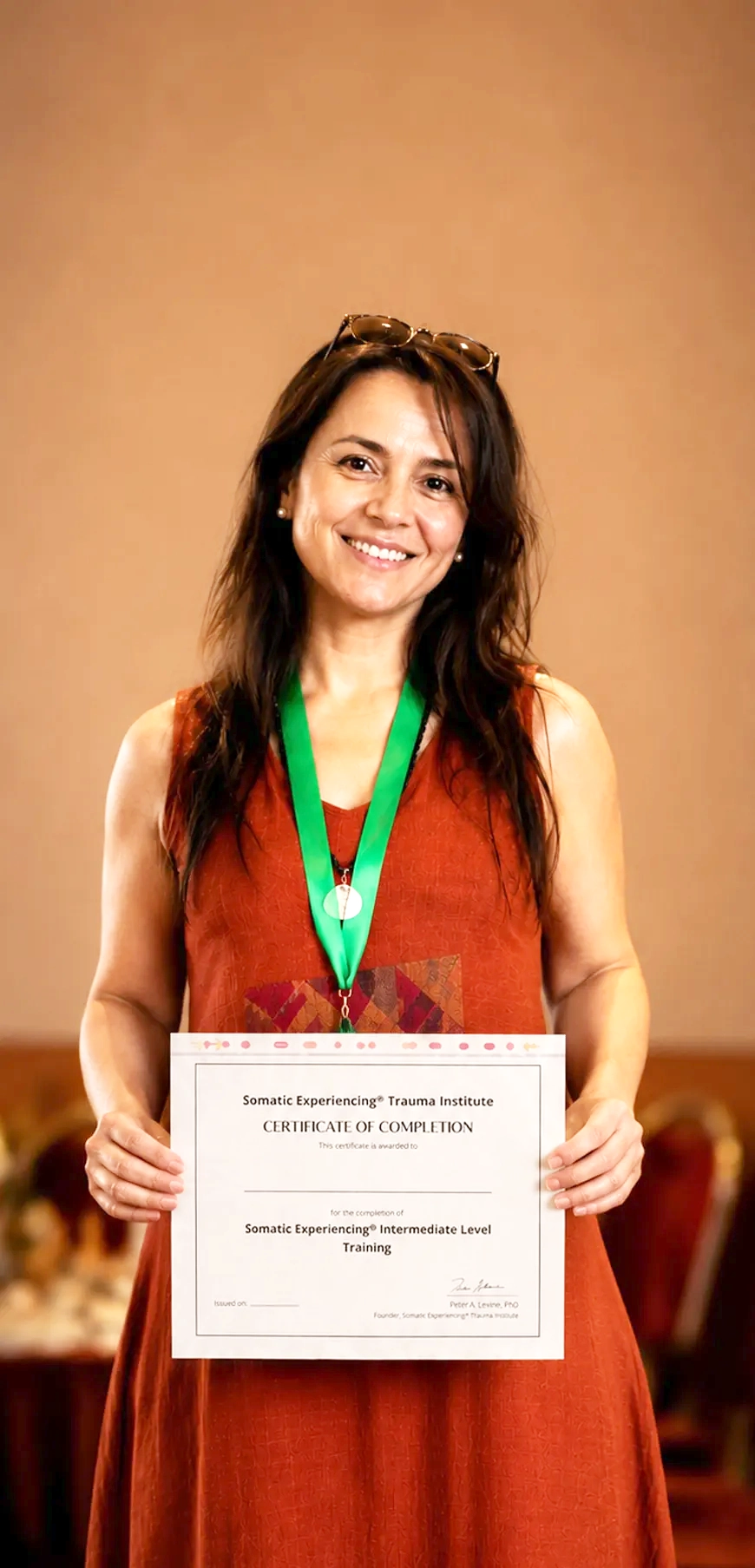
Intermediate Level Training
Learn about the different categories of trauma as addressed in the SE model. Learn the primary characteristics and hallmarks of each category of trauma, as well as specific approaches and interventions for working with each category effectively. Typically consists of three 6-day live training modules.
- Global High Intensity Activation (GHIA): pre- and peri-natal trauma, early trauma, anesthesia, suffocation, choking, drowning
- High Impact/Failure of Physical Defense: falls, traumatic brain injury, motor vehicle accidents, and other high-impact accidents
- Inescapable Attack: assault, animal attack, rape or sexual abuse, inhibited escape
- Physical Injury: surgery, poison, burns, physical injury due to accident
- Natural and Man-Made Disasters, Horror: natural disasters (e.g. earthquakes, fires, etc.), war, terrorism, torture, ritual abuse, horror (e.g. witnessing abuse, causing harm to another)
- Emotional Trauma: severe neglect, severe loss, ongoing abuse
Advanced Level Training

Advanced Level Training
Learn to work with complex trauma and syndromes. Expand on the use of touch in SE practice. Typically consists of two 6-day live training modules.
- Learn about the importance of stabilization when working with complex trauma
- Explore the SE concept of “coherence” in working with complex trauma
- Refine touch skills for supporting containment and coherence
- Learn about the interrelationship between dysregulation of the ANS and the SE model of syndromes (non-reciprocal relationship between the sympathetic and parasympathetic nervous systems)
- Develop a deeper understanding of the Polyvagal Theory as it relates to working with syndromes
- Refine the necessary SE skills of “titration” and “pendulation” when working with highly sensitive and syndromal clients
- Learn the SE model for working with the eyes
- Develop SE touch-based skills for working with different categories of trauma
- Understand how SE uses joints, body diaphragms, and the viscera to access ANS responses and to support completion of incomplete survival responses
- Explore scope-of-practice issues relating to the integration of SE and SE touch into professional practice